 Charis Development
By Rev. Romesh Prakashpalan, a minister of the Free Church of Scotland (Continuing) and the pastor of Zion Presbyterian Church, Fredericksburg, Virginia
Recently, many have wondered if plagiarism is such a big deal. The occasion is the controversy around the apologist Wesley Huff. Huff has acknowledged problems with his work, and Apologetics Canada has said it is reviewing it. This article does not intend to investigate Mr. Huff’s problems.
But the controversy has raised a question about preaching. Is it sinful for a minister to preach another man’s sermon as his own?
This article addresses that question. It won’t do so from every angle, and stealing another man’s sermon is sinful from many different angles. Instead, the article focuses on a much neglected truth: that both the preparation and the delivery of a sermon are deeply spiritual affairs that require a minister to wrestle with God.
Preaching another man’s sermon as one’s own is sin against God, against the man whose labors were taken, and against the flock that trusted their shepherd to feed them himself.
The reason lies in what preaching actually is.
I. A Work of the Spirit, in the Study and in the Pulpit
Preaching is not a mere public speech or Bible lesson. The preached Word is a means of grace, and the Spirit of God works by it.
Preparation
In fact, even before the minister steps into the pulpit, in his study, he depends on the Spirit to give insight into the text, to carry the Word home to the conscience, and to guide the work and make it effectual. He must be affected by its message himself, and pray over the souls in his congregation as the message is shaped.
This is the labor Paul laid on Timothy:
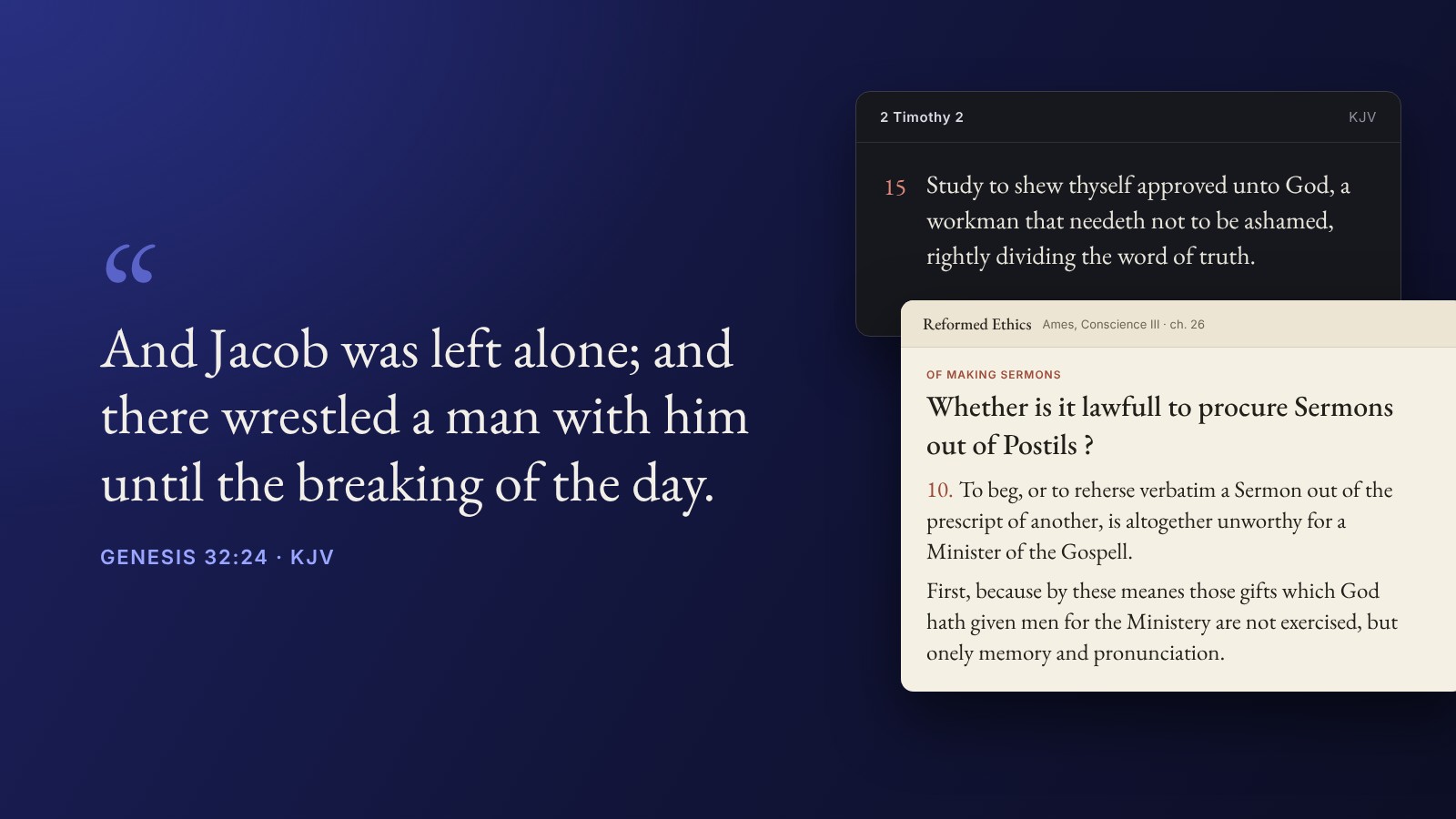
“Study to shew thyself approved unto God, a workman that needeth not to be ashamed, rightly dividing the word of truth.” (2 Timothy 2:15, KJV)
“Meditate upon these things; give thyself wholly to them; that thy profiting may appear to all.” (1 Timothy 4:15, KJV)
Notice this: that thy profiting may appear to all. The congregation is meant to see the fruit of the minister’s own growth in the Word. He is to give thyself wholly to them.
Delivery
But after preparation, comes the delivery. That too must be from the liberty that only the Holy Spirit can provide. The Apostle Paul disclaimed every other kind of power:
“And my speech and my preaching was not with enticing words of man’s wisdom, but in demonstration of the Spirit and of power:” (1 Corinthians 2:4, KJV)
In the act of preaching, a minister is moved by a consideration of the souls before him, and shapes and reshapes the message being preached by Spirit-given power and liberty. Whole sections of his outline may be skipped or added to based on how he perceives the Spirit shaping his message in realtime.
In this way, preaching is eminently Spirit-filled. A true preacher will tell you that there is nothing like it this side of heaven.
II. A Wrestling That Cannot Be Borrowed
But let us go back to the preparation, as that is the focus of this article. Sermon preparation is less like composition and more like wrestling. It is an exercise that searches the mind and heart of the preacher before it is preached to the congregation. Like Jacob at Peniel, the minister is held by the Word through the night and comes away both blessed and wounded:
“And Jacob was left alone; and there wrestled a man with him until the breaking of the day.” (Genesis 32:24, KJV)
A sermon that has come out of that kind of struggle bears its marks. It carries the preacher’s own convictions, his own repentance, his own discovery of Christ in the passage. This is needed for moral authority. The minister can say, in effect, “I have met with God in this text.”, and that is part of the power that comes in delivery. A man is gripped with the burden of the text that comes by the Holy Spirit.
This is the work of the Spirit that plagiarism counterfeits. The plagiarist takes another man’s wrestling with God, the fruit of that man’s prayers, conviction, and illumination, and presents it as his own. He offers his people the appearance of a minister who has been alone with God over the text when he has not. He has neither come away with a limp or a blessing from God.
The Puritan divine William Ames saw this clearly. Among his reasons why it is “altogether unworthy for a Minister of the Gospell” to preach a sermon taken from another, he put the loss of the sermon’s very power:
“the force and efficacie of that Sermon is lost, which is not fetcht from the certaine judgement, and inward affection of the speaker”¹
A borrowed sermon may be orthodox and still ring hollow in the mouth of the man who did not labor over it.
Later in the same chapter, Ames makes the positive side of this point. He asks what most makes a sermon effectual on the conscience, and answers:
“Next to the evidence of truth, and the will of God drawne out of Scripture, nothing makes the Sermon more to pierce, then when it is apparent that it comes out of the inward affection of the heart without any affectation. To this purpose it is very profitable, if besides the dayly practise of pietie we use serious meditation, of fervent prayer to worke those things upon our owne hearts, which we would perswade others of.”²
That is the wrestling in the study. The minister first works the truth on his own heart by meditation and prayer, and only then urges it on others. No one can do that for him.
III. A Trust Betrayed
There is another problem: the scandal such plagiarism brings on a congregation. A minister is called by a particular congregation to serve them. They support him so that he may give himself to the Word (1 Timothy 5:17–18).
In addition, the shepherd who feeds the flock with another man’s food does not truly know the flock. A stolen sermon was written for another congregation and another set of burdens. Speaking from personal experience, it is difficult for me to preach a sermon I have preached to my congregation when I go as a guest elsewhere. The sermon often feels alien, and I usually have to rework it completely. The exegesis is fine. The application and heart of it can change considerably.
Ames makes this point: those who preach another’s sermon “cannot aright cut the Word of God by a fit accommodation of it to the condition of the hearers, according to the variety of occasions.”¹ In the chapter he also says the “principall worke of the Sermon” is “in the use and application,” which is the part most tied to a particular congregation.
Ames also says that such a practice “makes them also to be despised among many.”¹ The scandal is not modern. It was already recognized in the seventeenth century.
IV. A Right Use of Other Men’s Labors
None of this means a minister must prepare in isolation, as though no one had ever preached the text before him. Reading Calvin, Poole, Henry or Caryl on a passage is not plagiarism. But one has to weigh their insights. One has to understand how it might apply or not apply to the congregation before the minister.
William Ames drew this line with care in his Conscience, with the Power and Cases Thereof. In the chapter “Of making Sermons” he takes up the question “Whether is it lawfull to procure Sermons out of Postils ?” (that is, out of the printed books of ready-made sermons in circulation in his day). He first set down the abuse:
“To beg, or to reherse verbatim a Sermon out of the prescript of another, is altogether unworthy for a Minister of the Gospell.
First, because by these meanes those gifts which God hath given men for the Ministery are not exercised, but onely memory and pronunciation.
Secondly, because they that doe so, cannot aright cut the Word of God by a fit accommodation of it to the condition of the hearers, according to the variety of occasions.
Thirdly, because the force and efficacie of that Sermon is lost, which is not fetcht from the certaine judgement, and inward affection of the speaker : which cannot bee expected from them, that speake all out of a prescript forme.
Fourthly, because this manner of doing, makes Ministers not increase in knowledge, but in memory onely.
Fiftly, it makes them also to be despised among many.”¹
Then, immediately, he guarded against the opposite error:
“Yet Commentaries, and godly Sermons made by others, may be of great use to a Minister lesse exercised.
First, because imperfect beginners are excited and directed in the right way, by the example of such as are more perfect, and of greater yeares.
Secondly, because divers things are to bee found in such kind of writings, which those that are lesse exercised may transferre into their owne use.
Thirdly, because some things are propounded with more confidence by beginners, when they see the same things used by the gravest Divines.”¹
Ames does not object to a minister learning from other men’s sermons. He objects to a minister preaching them. The commentary and the godly sermon are servants in the study. But what they supply is to be transferred “into their owne use”: taken up, digested and made the preacher’s own through his own meditation.
Notice too what is at stake in his first and fourth reasons. Preaching another’s sermon leaves the minister’s God-given gifts unexercised and keeps him from growing in knowledge. Plagiarism robs the plagiarist of the growth God uses the labor of preparation to produce, and so it robs his people of a minister who is maturing in the Word.
V. A Better Way: Honest Labor as a Good Work
Now, in one way, it is understandable that the pressure of the ministry leads men to be tempted to plagiarize the work of others. But it must be resisted. Here are some considerations to help resist by the strength of God’s power.
- Remember that preaching is an eminently spiritual exercise, and particularly in this area, it is your duty to God to labor honestly. Additionally, it ought to be labor that you enjoy. Perhaps your own communion with Christ has diminished and the ministry is simply one where you go through the motions. Rather than enjoying the wrestlings with God. But preparation is time spent in communion with the Lord.
- If you are pressed for time due to a busy week of pastoral ministry (not due to negligence), better to preach a simpler sermon. God will bless his Word to the hearers and you may be amazed by how he may move you in the delivery of it. Spend more time in prayer.
- Preach without notes or without using much of an outline more often. Preach in varied places like nursing homes or in the open air and discover the liberty that comes from knowing intimacy with Christ in preaching. That will aid your regular pulpit ministry and grant liberty that you feel you lack.
Ministry is difficult, brothers. But as the Apostle wrote, “for when I am weak, then am I strong” (2 Corinthians 12:10, KJV). Press on by the same power that brings the dead to life and translates them from darkness to the glorious light of Christ. This is where the “Well done, thou good and faithful servant” (Matthew 25:21, KJV) commendation comes from. While we are “unprofitable servants”, we look forward to the Lord’s commendation for very gladly spending and being spent.
Charis Development is supported by donations. Its applications, including Brown Bible Study and Reformed Ethics, are free to use, with no advertising.
Notes
- William Ames, Conscience, with the Power and Cases Thereof, Part III, Book IV, Chapter 26, “Of making Sermons,” Question 3, §§10–11 (print pp. 72–73). Read the full chapter in the Reformed Ethics library.
- Ames, Conscience, Book IV, Chapter 26, Question 13, §31 (print p. 78). Read the full chapter in the Reformed Ethics library.