 Charis Development
This article was written by AI, from an outline fed to it by a human.
Every minister knows the two halves of sermon preparation. First: what does the text say? Then the harder one: what does it require of my people?
Charis now has a tool for each half. Brown Bible Study opens the text: the original languages, the King James Version, the grammar and the old commentators. Reformed Ethics opens the application: cases of conscience, answered from the books.
Here is a real afternoon’s work. The sermon is on honouring parents, and the text is Ephesians 6:1-3:
“Children, obey your parents in the Lord: for this is right. Honour thy father and mother; (which is the first commandment with promise;) That it may be well with thee, and thou mayest live long on the earth.”
Step one: let Machen parse the text
Open Ephesians 6 in Brown Bible Study and choose Grammar. The verse is laid out clause by clause from Scrivener’s Textus Receptus, every word parsed in plain English, with the grammar drawn from J. Gresham Machen’s New Testament Greek for Beginners (1923).
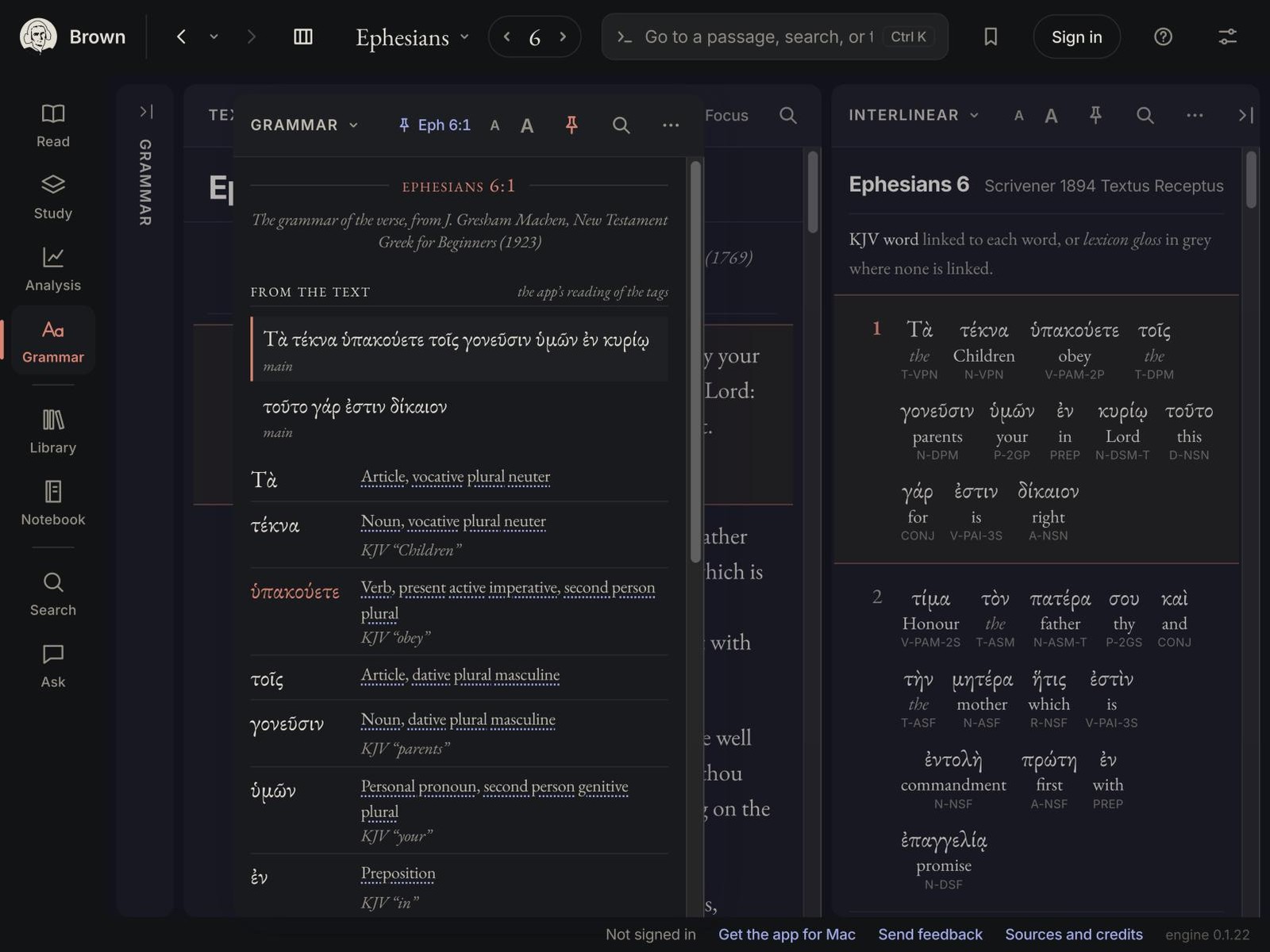
Two things stand out at once. ὑπακούετε (“obey”) is a present active imperative, second person plural: Paul directly addresses the children among his hearers. Then in verse 2 he quotes the fifth commandment, and τίμα (“Honour”) keeps the commandment’s own second person singular.
Move to verse 3 and the app flags a construction for you:
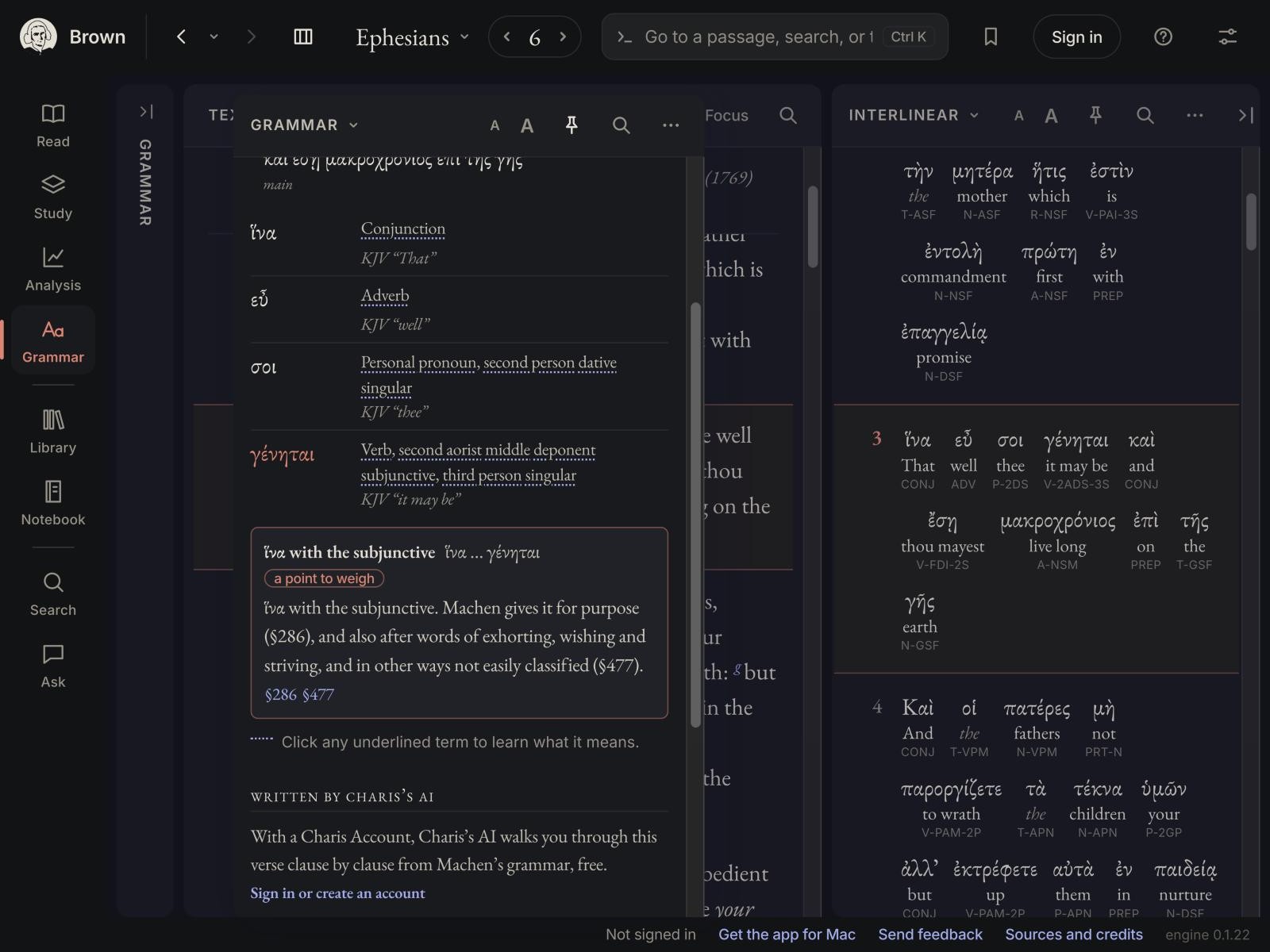
ἵνα with the aorist subjunctive γένηται, followed by the future indicative ἔσῃ. Machen gives ἵνα with the subjunctive for purpose (§286) and for other uses besides (§477), and one click opens the sections themselves. The app marks the construction “a point to weigh,” and rightly so. Grammar names the construction; the context must say what it is doing. Here Paul is quoting the promise attached to the fifth commandment, and the clause sets out the blessing promised to those who honour their parents.
Step two: ask the commentators
Now bring in the commentators, and not one at a time. Open Ask and put the question in your own words: What does it mean for children to obey their parents “in the Lord”? Charis’s AI reads all twenty-six commentators on the verse and answers in a few paragraphs, every sentence tied to the writer who said it.
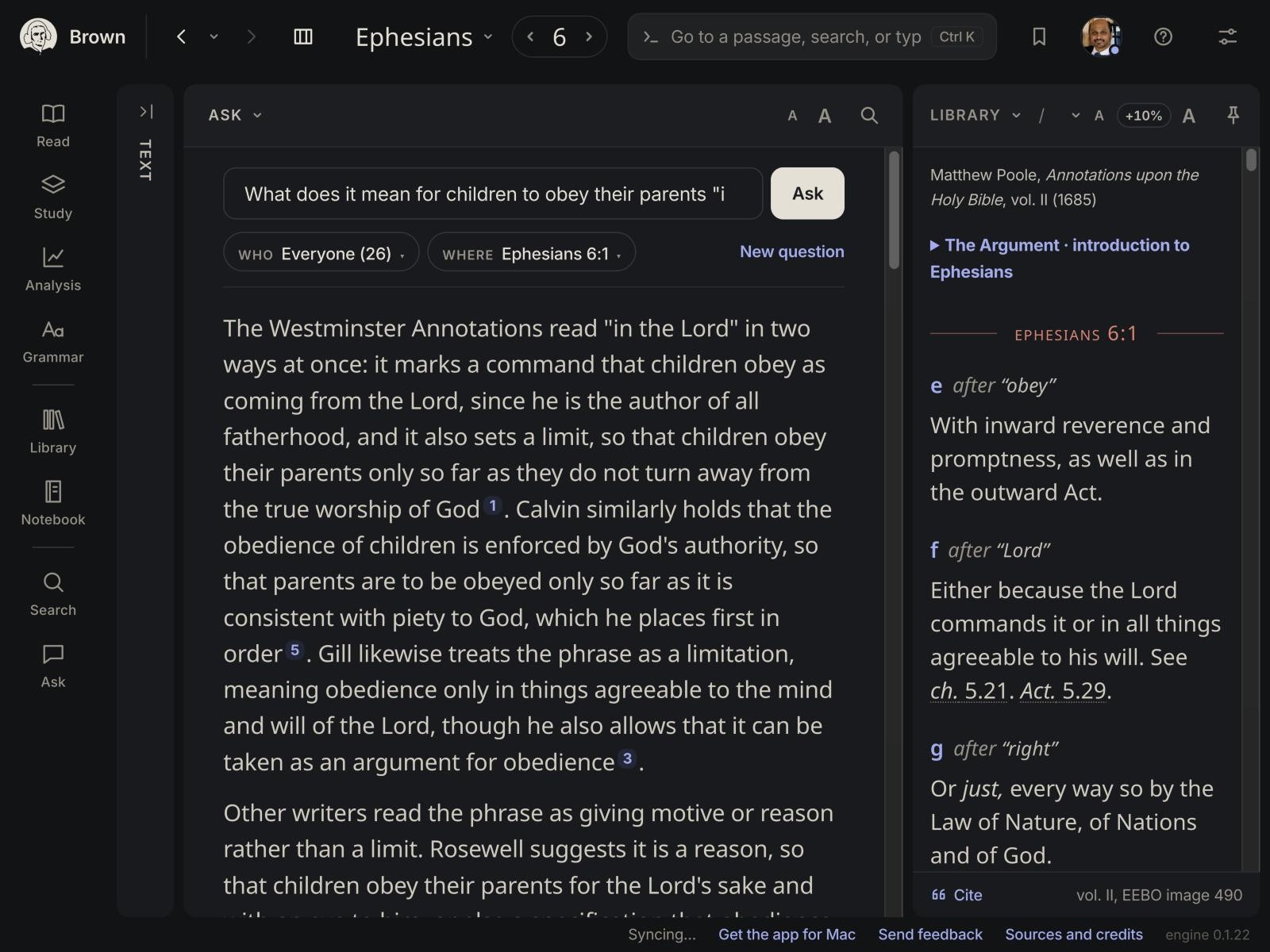
The answer sorts the commentators for you. The Westminster Annotations, Calvin and Gill read “in the Lord” as a limit: parents are to be obeyed, in Calvin’s words, “so far only as is consistent with piety to God.” Rosewell, in Matthew Henry’s Exposition, and Fausset read it as the motive: obey for the Lord’s sake. Poole’s continuators allow both.
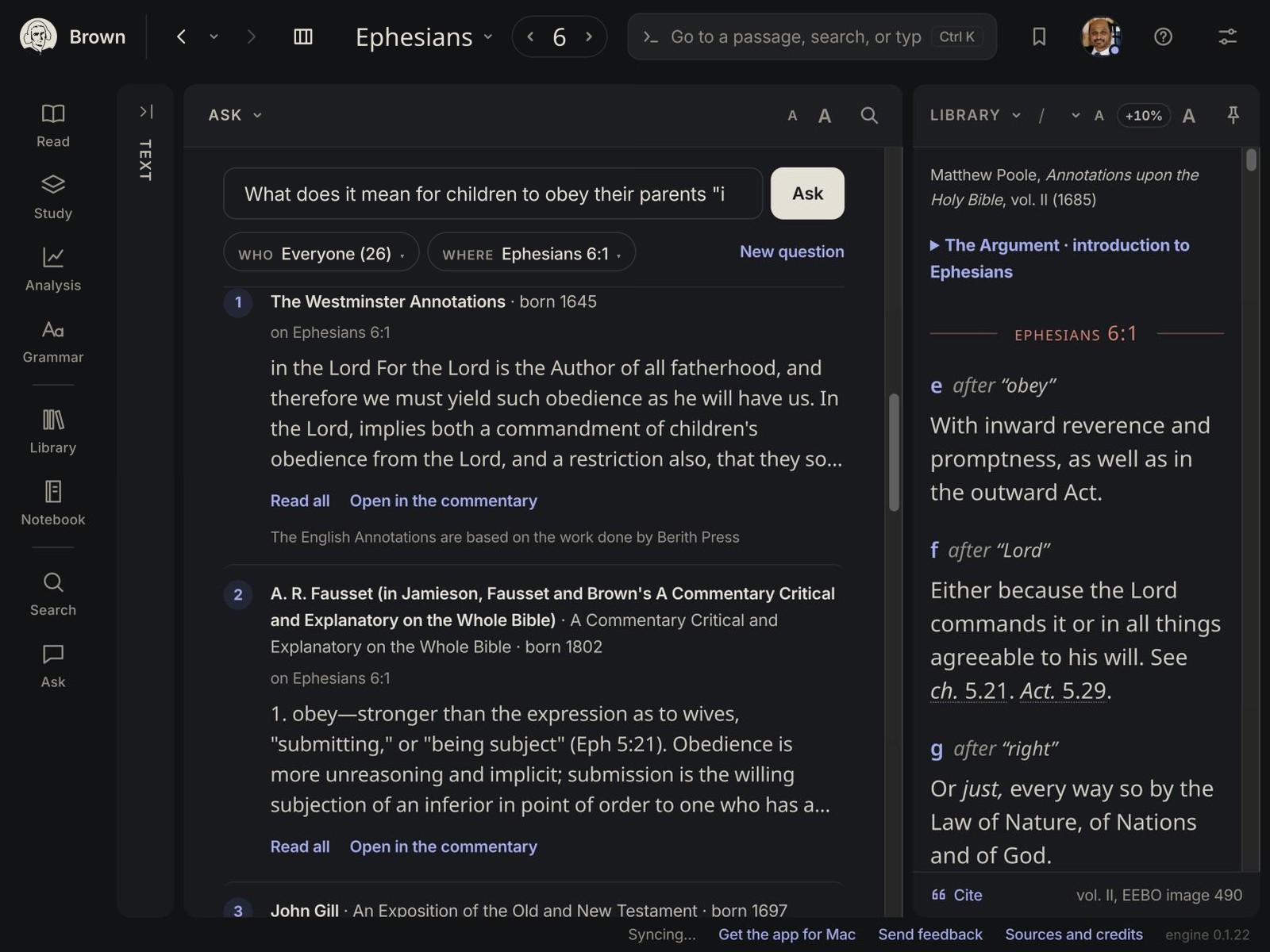
It reports what each writer says and does not judge between them. And it shows its working: beneath the answer, every numbered reference gives the commentator’s own words, with a link to open the commentary at that place.
There, from one question, is the skeleton of a sermon:
- The Requirement of Obedience: “Children, obey your parents”
- The Rule of Obedience: “in the Lord: for this is right”
- The Reward of Obedience: “the first commandment with promise”
But that limit raises the question every thoughtful hearer will ask. So far only as is consistent with piety to God. And when a parent’s command is not?
Step three: take the hard question to Reformed Ethics
This is where exegesis becomes casuistry, and where Reformed Ethics takes over. Ask it in your own words:
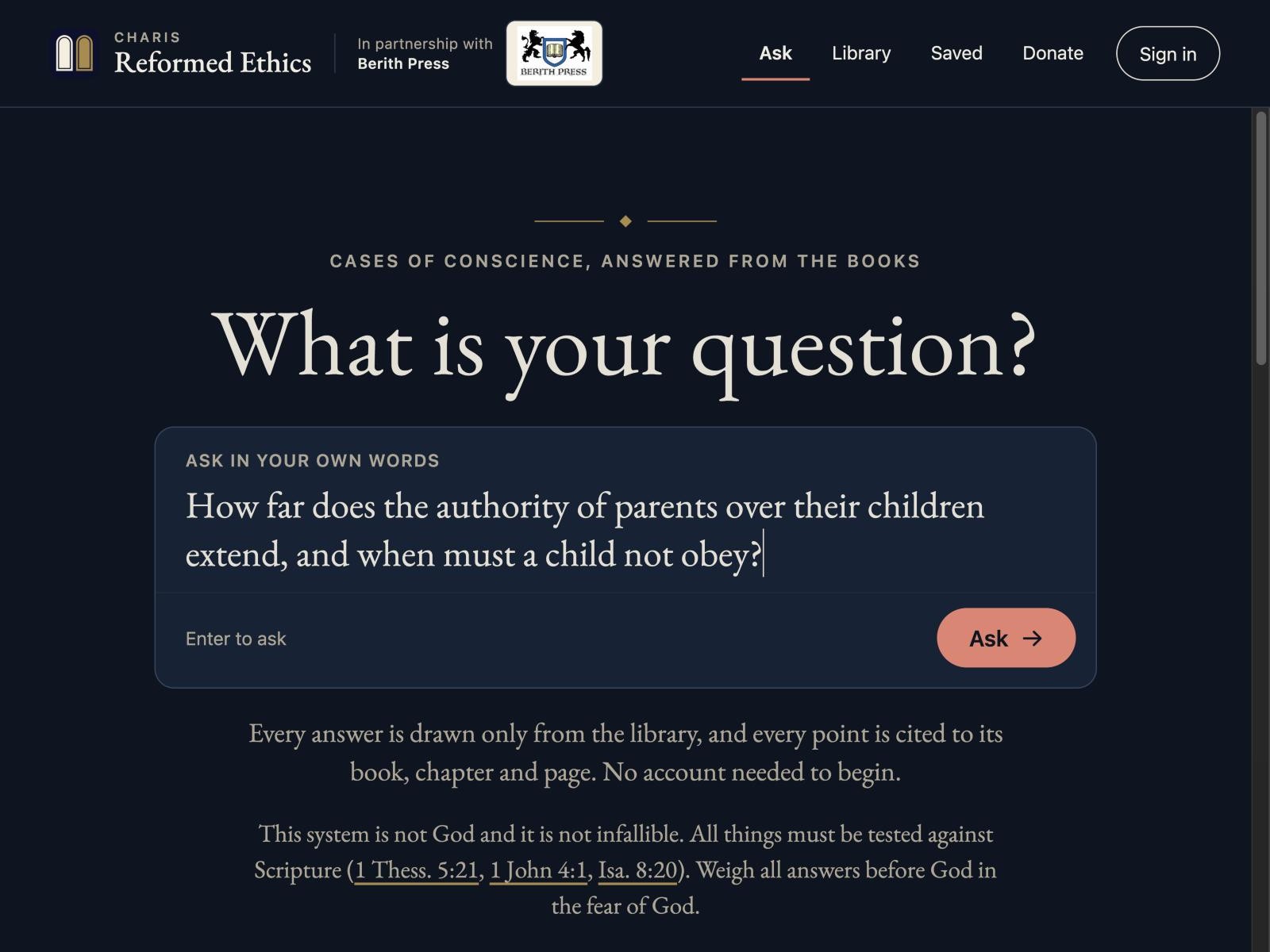
Every answer is drawn only from the library, and every point is cited to its book, chapter and page. Scripture references link straight back to Brown Bible Study.
Within seconds the answer streams in, filed under the fifth commandment, with the verdict up front:
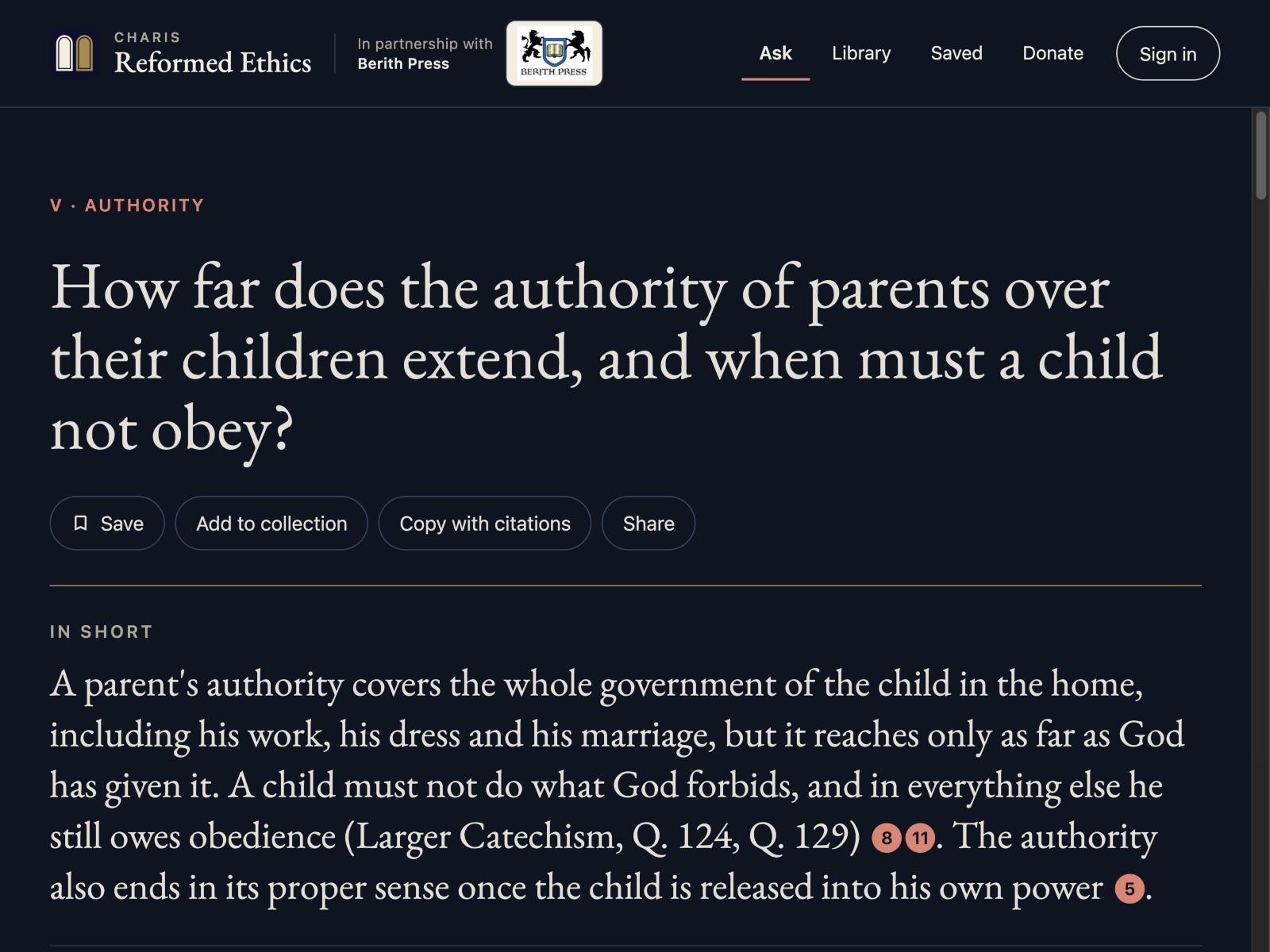
It begins where a Reformed answer should, with the Larger Catechism (Q. 124 and Q. 129): a parent’s authority is a power received from God. Then it brings the writers to bear on the exact question the commentators raised, each point numbered to its source:
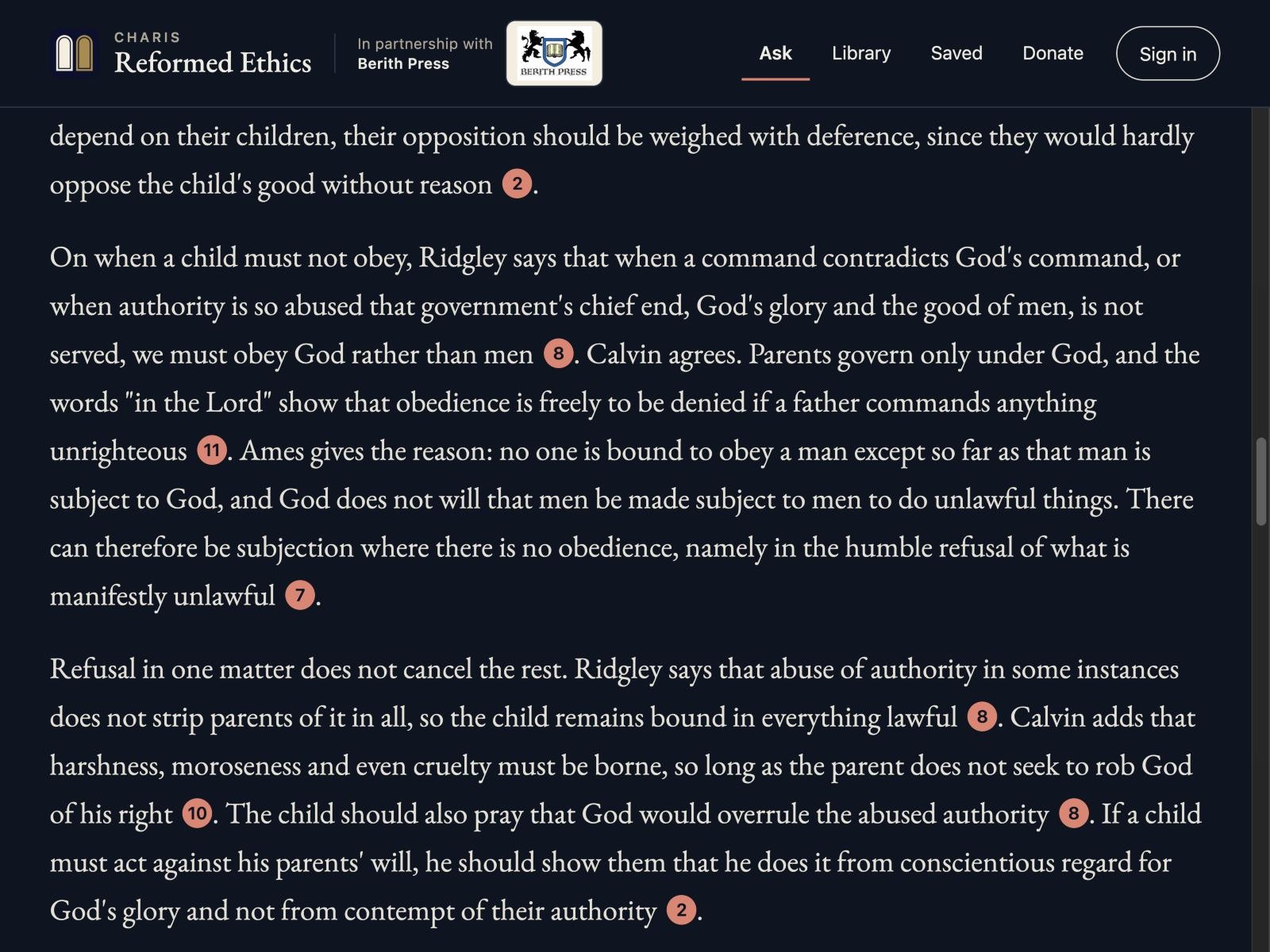
Calvin on “in the Lord.” Ames on subjection without obedience. Ridgley on obeying God rather than men, while still obeying the same parents in lawful things. Calvin again on bearing even a harsh parent with patience. The answer even marks where the authors differ, and what the library does not say.
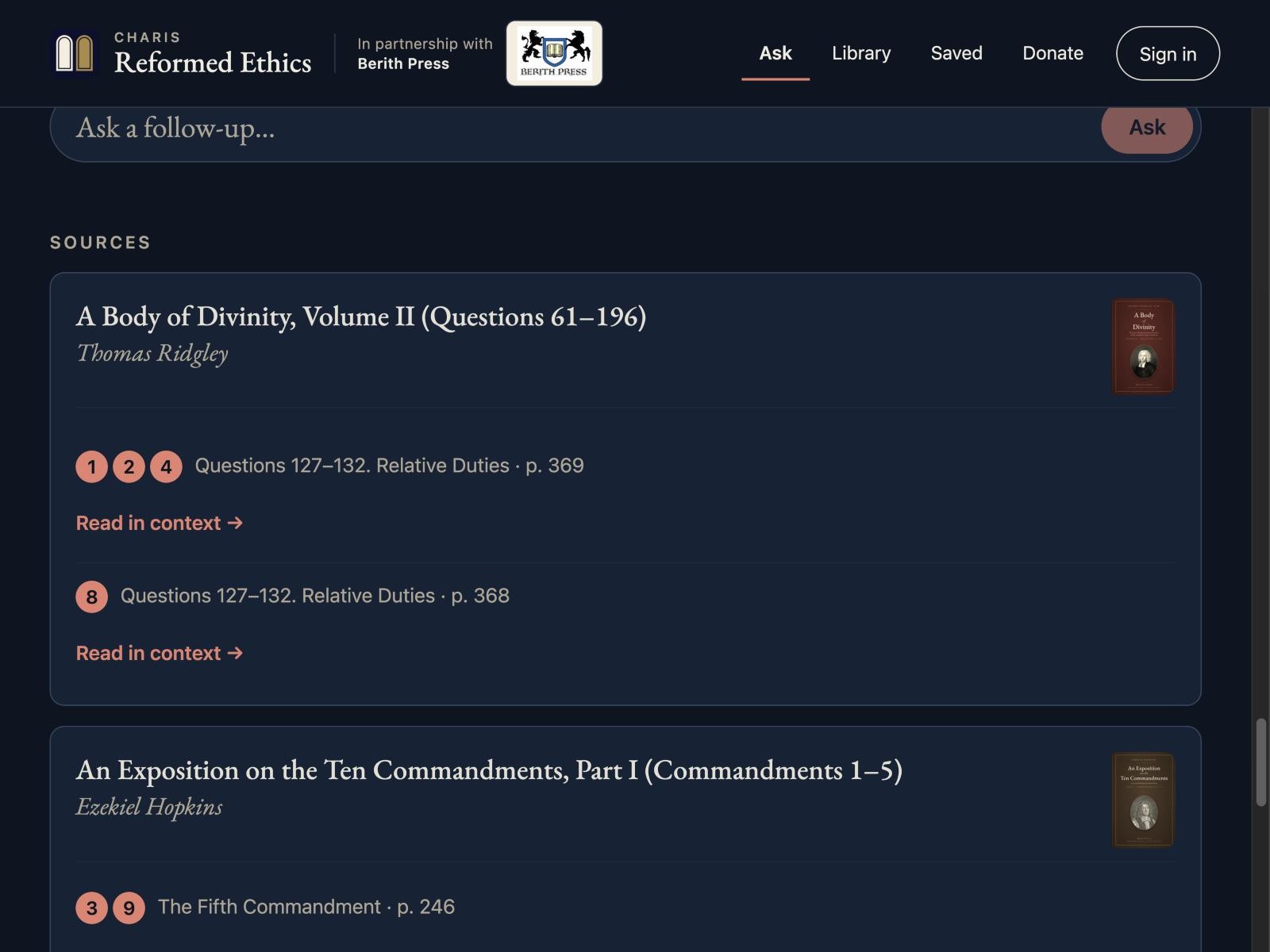
And nothing is taken on trust. Every numbered citation leads to its book, chapter and page:
Then go further into the library and read the divines for yourself. Here is Thomas Watson on the fifth commandment, in A Body of Practical Divinity (1692):
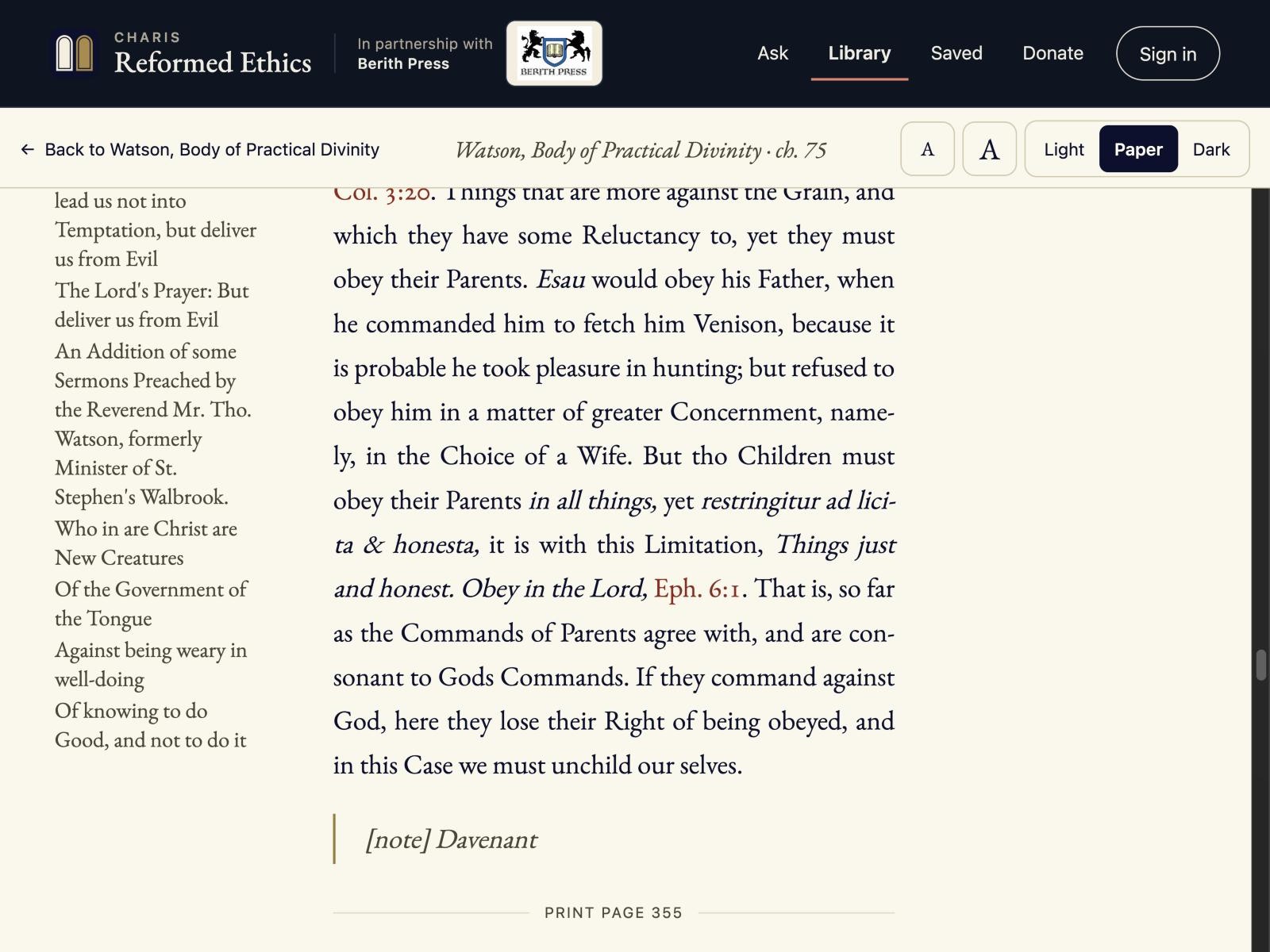
Children must obey “in all things,” says Watson, yet “with this Limitation, Things just and honest.” And then, expounding our very text: “If they command against God, here they lose their Right of being obeyed.”
That is the application, grounded and quotable. Parental authority is real, broad and to be obeyed even against the grain; and it is bounded by the authority of the God who gave it.
Watson does not stop at obedience, either. He goes on to the honour shown “in relieving their Wants”: the grown child caring for an aged parent. The text that began with a command to children ends in a good work for every one of us.
Step four: weigh the promise
The sermon’s third head is the promise, and it deserves the same care: “That it may be well with thee, and thou mayest live long on the earth.”
Back in Brown Bible Study, click μακροχρόνιος and dig into the word.
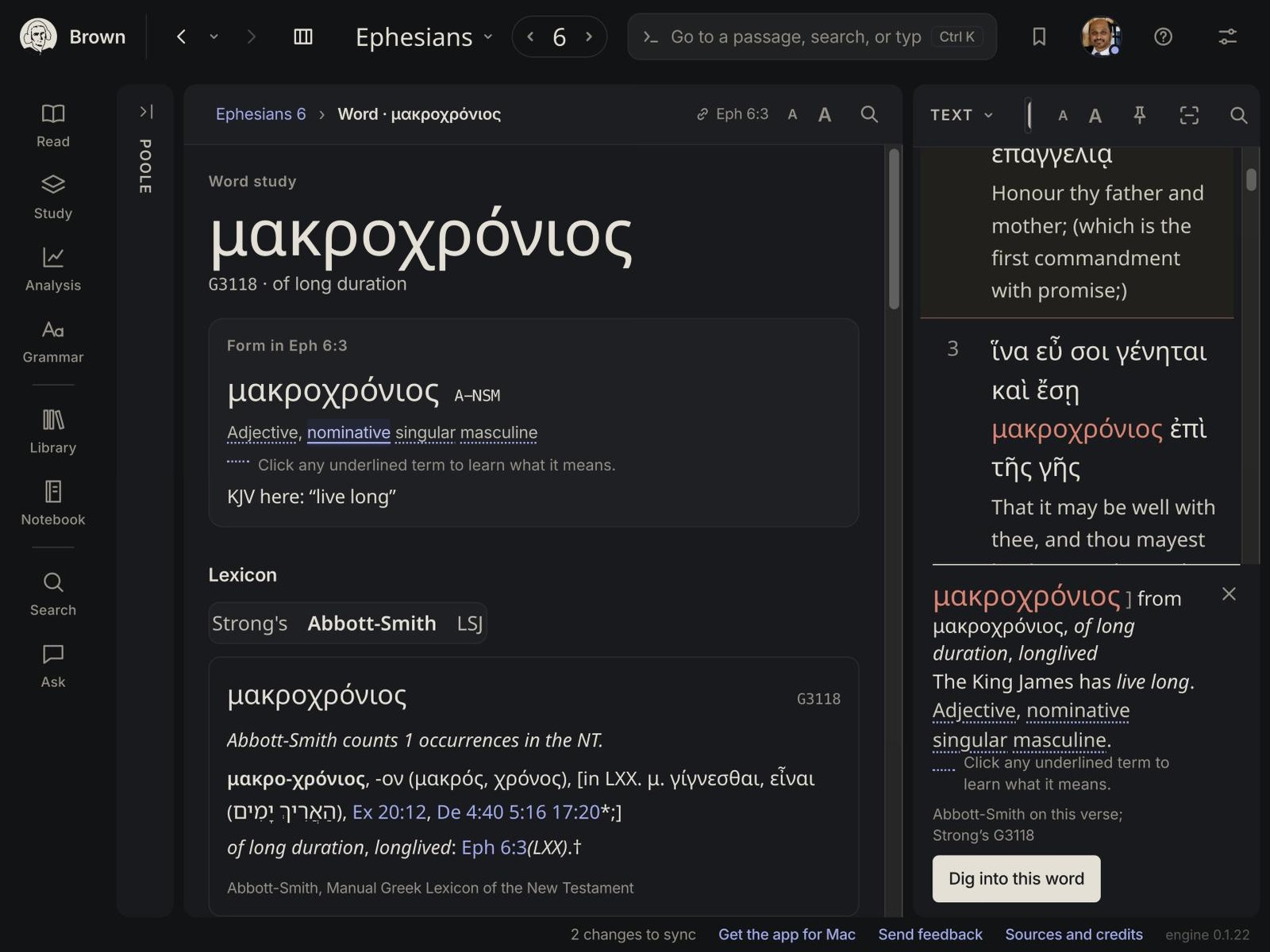
“Live long” turns out to be a single Greek adjective, “longlived,” and Abbott-Smith counts this as its only occurrence in the New Testament. He marks it as the Septuagint’s expression, pointing to Exodus 20:12 and Deuteronomy 5:16. Paul is using the commandment’s own word.
But there is something he does not use. Ask the commentators what the promise is, and how it holds for believers now:
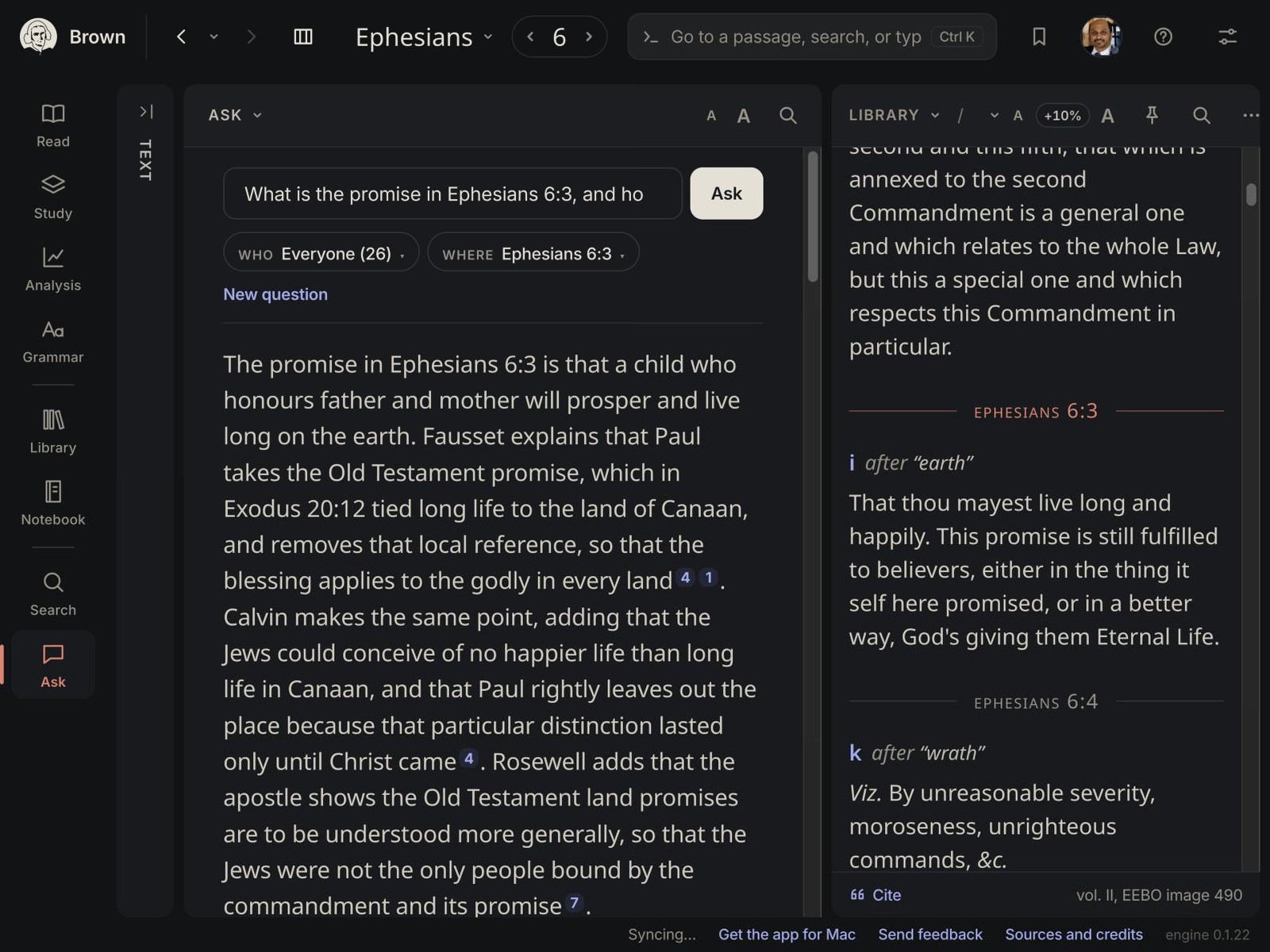
They notice what Paul leaves out. The commandment promised long days “upon the land which the LORD thy God giveth thee” (Exodus 20:12); Paul says only “on the earth.” In Calvin’s words, Paul “has properly left out the mention of a place.” The promise is no longer tied to Canaan.
And its limit? Not every dutiful child lives to old age, and a congregation knows it. The commentators answer that the promise still holds, “either in the thing it self here promised, or in a better way,” as Poole’s continuators put it. Fergusson adds that the obedient child, “whether he live long or short, doth alwayes live well, because he liveth in Gods favour.”
Take the same question to Reformed Ethics, and the Larger Catechism gives the rule in a line:
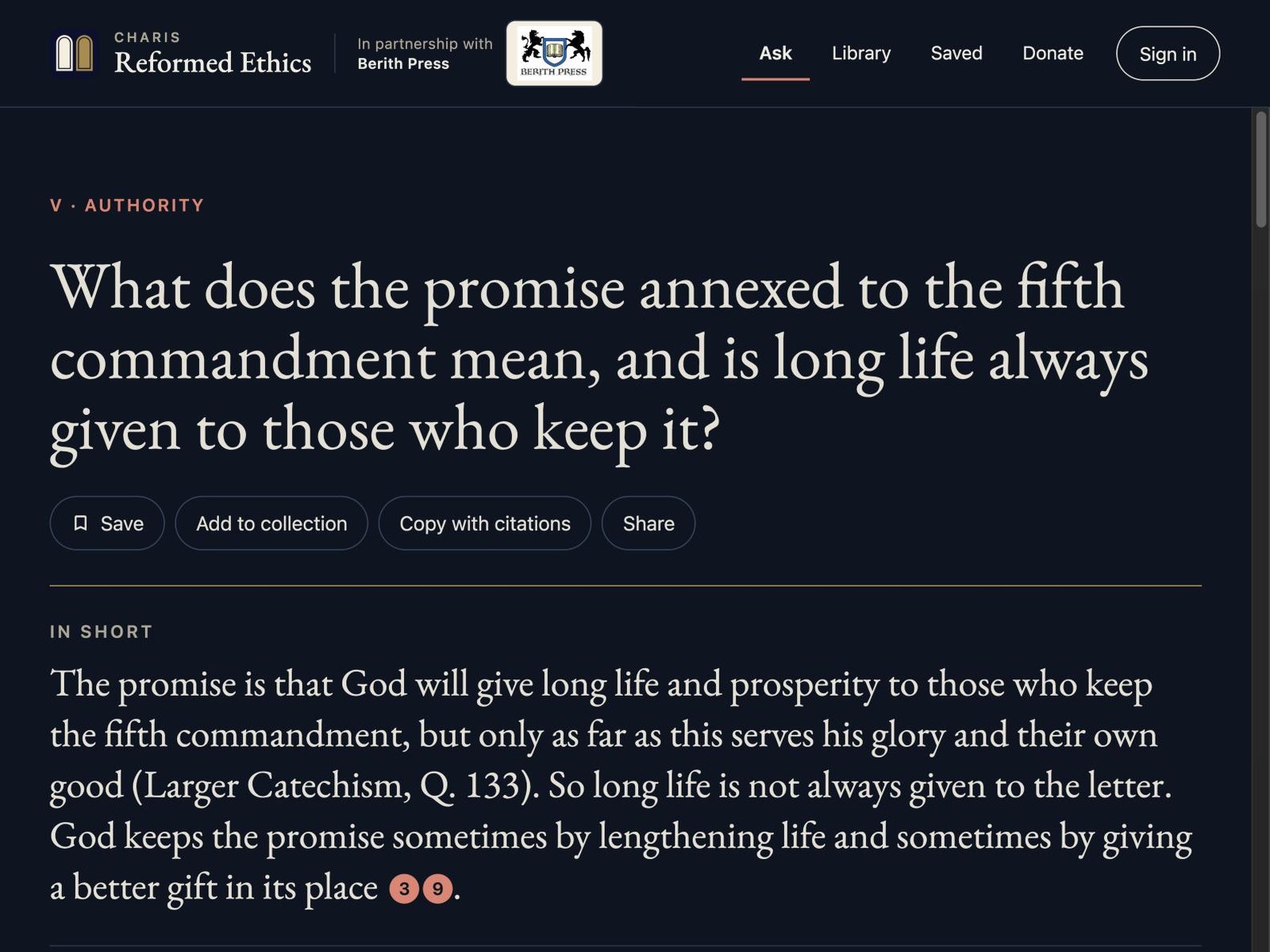
The promise is of long life and prosperity “as far as it shall serve for God’s glory and their own good” (Larger Catechism, Q. 133). The answer then cites Ridgley, Hopkins, Watson and Calvin on why a shorter life does not break it.
That is a third head a minister can preach with a clear conscience: a real promise, wider than Canaan, and bounded by the glory of God and the good of his children.
One afternoon, one text
The grammar parsed with Machen. The commentators compared in a single question. The hard case answered from the Catechism, Calvin, Ames, Ridgley, Hopkins and Watson. The promise weighed, from its one Greek word to its limit in the Catechism. An outline in hand, and an application that will stand up to the questions it provokes.
None of this replaces the minister’s own labour over the text, or his prayer. As the Reformed Ethics home page itself says, all things must be tested against Scripture. But it does put a remarkable library on the desk, and it is free to use.
Try it with next Lord’s day’s text:
- Brown Bible Study: for the text, the grammar and the commentators
- Reformed Ethics: for application and principles
Both are Charis applications: free, with no advertising, and supported by donations.